A denture that shifts when you eat or speak can affect both comfort and confidence in everyday life. If you have lost several or all of your teeth, you may be wondering which option offers greater long-term stability: traditional dentures or dental implants?
In general, implant-supported restorations provide greater stability than traditional removable dentures. While dentures rely mainly on the gums and surrounding oral structures for support, dental implants are anchored directly in the jawbone, creating a more stable foundation for the restoration.
Over time, this added support can mean less movement, more predictable chewing and a feel that is closer to natural fixed teeth. However, dental implants require surgery and may not be suitable for everyone. The best option depends on factors such as your oral health, jaw anatomy, available bone and treatment goals.
What Is the Difference Between Dentures and Dental Implants?
The main difference between dentures and dental implants is how they are supported.
A traditional denture is a removable dental prosthesis used to replace several teeth or all the teeth in an arch. It rests mainly on the gums and other tissues in the mouth.
A traditional denture can:
- be removed by the patient;
- replace several teeth or a full arch of teeth;
- avoid the need for implant surgery;
- require adjustments or relining over time;
- move to some degree while eating or speaking.
A dental implant, by comparison, is an artificial tooth root, usually made of titanium, that is surgically placed in the jawbone. Rather than replacing the visible tooth itself, the implant acts as an anchor for a dental restoration.
One or more implants can support:
- a single crown;
- a dental bridge;
- a removable implant-supported denture;
- a fixed implant-supported restoration;
- a full-arch All-on-X restoration.
After an implant is placed, the surrounding bone gradually heals and integrates with its surface. This process, called osseointegration, helps create a stable foundation for the restoration.
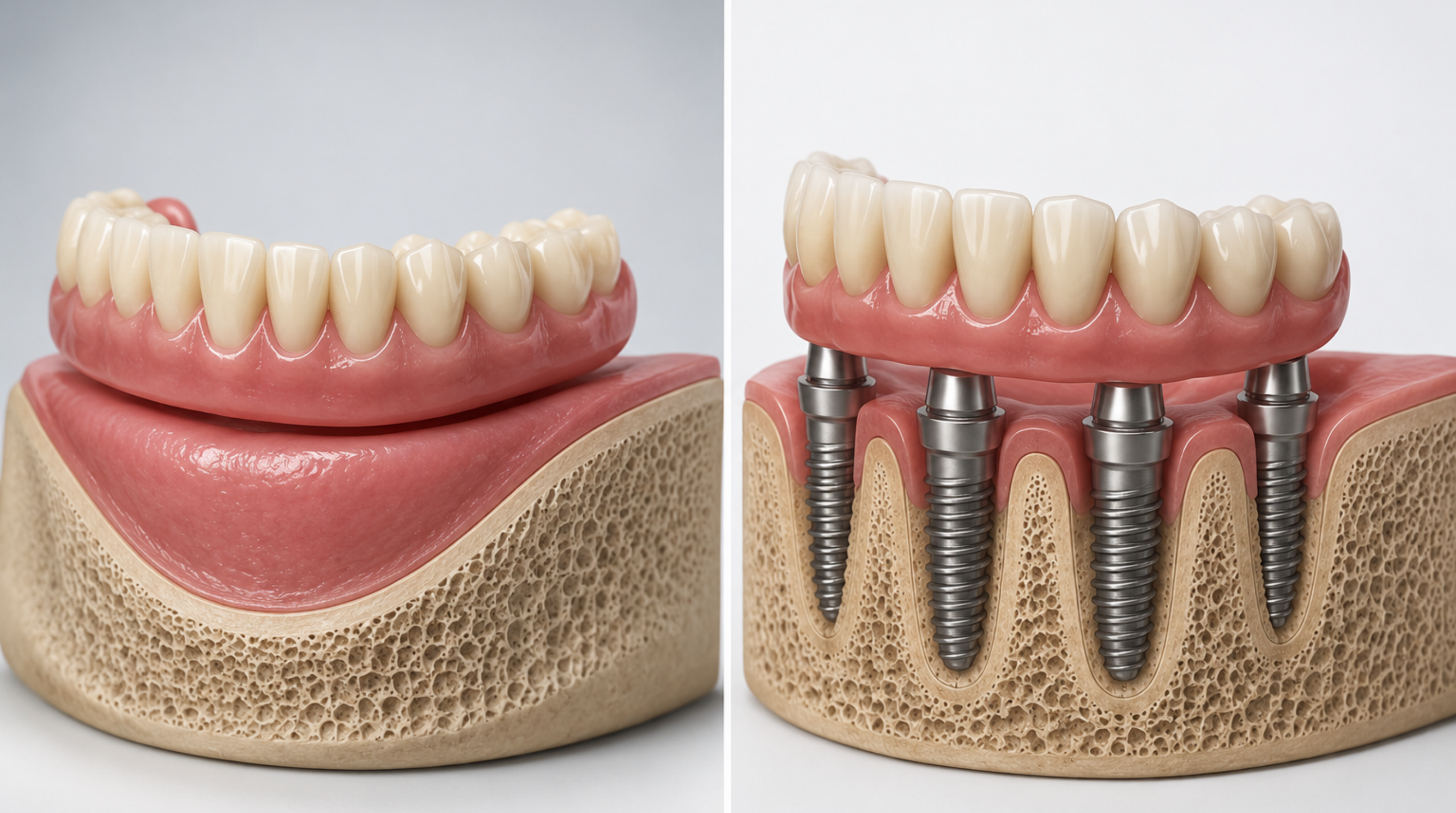
Key point: Traditional dentures rely mainly on the gums for support, while implant-supported restorations are anchored in the jawbone.
Dentures or Implants: Which Option Is More Stable?
For long-term stability, implant-supported restorations generally offer an advantage over traditional dentures.
Because implants are anchored in the jawbone, they provide a stable foundation for the restoration during biting and chewing. For patients who have lost all their teeth, research has also found improvements in oral function and patient-reported outcomes with implant-supported restorations compared with conventional complete dentures.
Depending on the type of restoration, implants can:
- reduce movement while eating or speaking;
- improve retention;
- provide more predictable chewing;
- reduce or eliminate the need for denture adhesives;
- support a fixed restoration in certain cases.
Why Can Dentures Become Loose Over Time?
A denture that once fit comfortably may become looser over the years because the shape of your mouth can change after tooth loss.
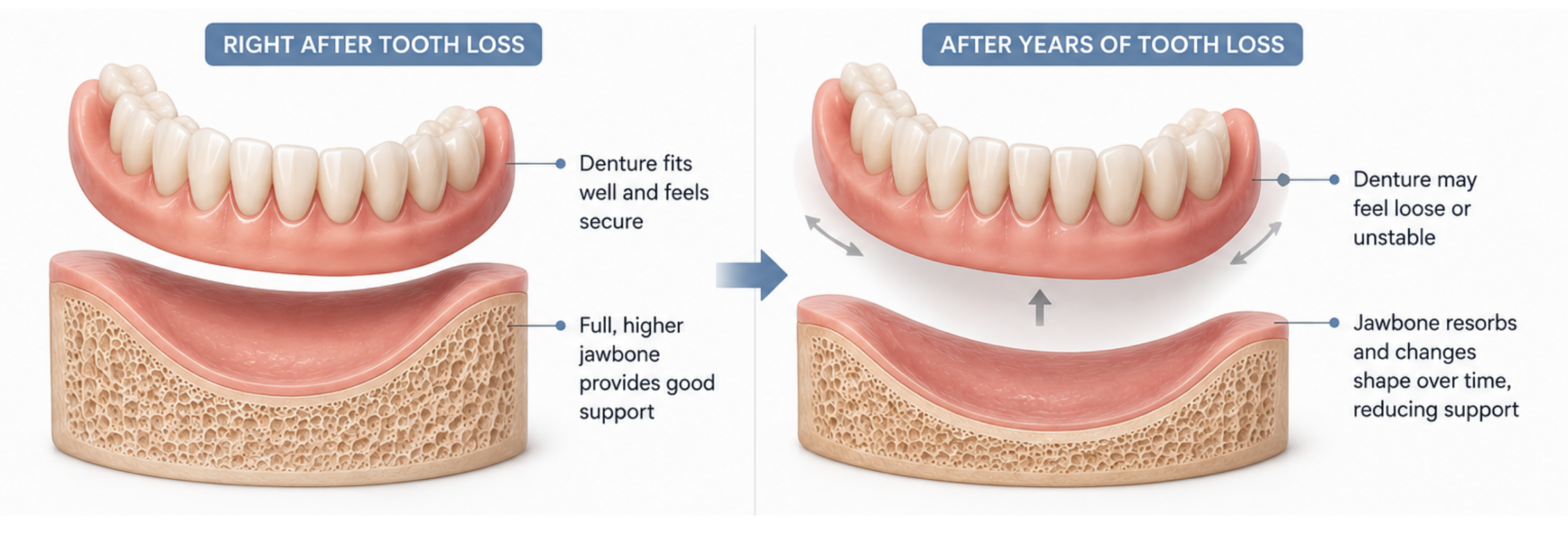
Without tooth roots, the jawbone in the area gradually remodels and can decrease in volume. These changes can alter the shape of the ridge and gums that support the denture, affecting how securely it fits.
Over time, you may notice:
- more movement while eating or speaking;
- reduced retention;
- a greater need for denture adhesive;
- gum irritation or pressure points;
- changes in the overall fit of the denture.
When this happens, an adjustment, reline or, eventually, a replacement denture may be recommended.
Not every denture will become significantly unstable. With a well-fitting prosthesis and regular dental follow-up, dentures can remain a functional option for many years.
Dentures vs. Dental Implants: A Long-Term Comparison
Dentures and implant-supported restorations differ in several ways that can affect comfort, function and long-term care.
| Criterion | Traditional Denture | Implant-Supported Restoration |
| Stability | May move during everyday use | Offers greater stability |
| Support | Rests mainly on the gums and oral tissues | Anchored to implants in the jawbone |
| Type of restoration | Removable | Can be removable or fixed |
| Chewing | May require more adaptation | Provides greater stability when chewing |
| Effect on bone | Does not provide the same stimulation as a tooth root | Helps preserve bone around functioning implants |
| Surgery | Generally not required | Requires surgical implant placement |
| Initial cost | Generally lower | Generally higher |
| Maintenance | Daily cleaning; adjustments or relining may be needed | Daily hygiene and ongoing prosthetic maintenance |
| Professional follow-up | Regular follow-up required | Regular follow-up required |
Neither option is maintenance-free. For implant-supported restorations, the health of the tissues surrounding the implants is also important for long-term success. Ultimately, the most appropriate option depends on your oral health, anatomy, needs and treatment goals.
Which Option Makes It Easier to Eat: Dentures or Implants?
Implant-supported restorations generally provide more predictable chewing than traditional removable dentures.
Because removable dentures can shift under pressure, some patients may need to modify how they bite or limit foods that are particularly hard, sticky or difficult to chew.
Implant-supported restorations offer:
- less movement while eating;
- improved retention;
- more predictable chewing;
- greater confidence during meals.
Can Dental Implants Help Preserve Jawbone?
Yes. Dental implants can help maintain the jawbone around them, although some bone changes can still occur over time.
Natural tooth roots transfer chewing forces to the jawbone, providing stimulation that helps maintain the surrounding bone. When teeth are lost, this stimulation decreases and the bone that once supported them will gradually shrink or resorb.
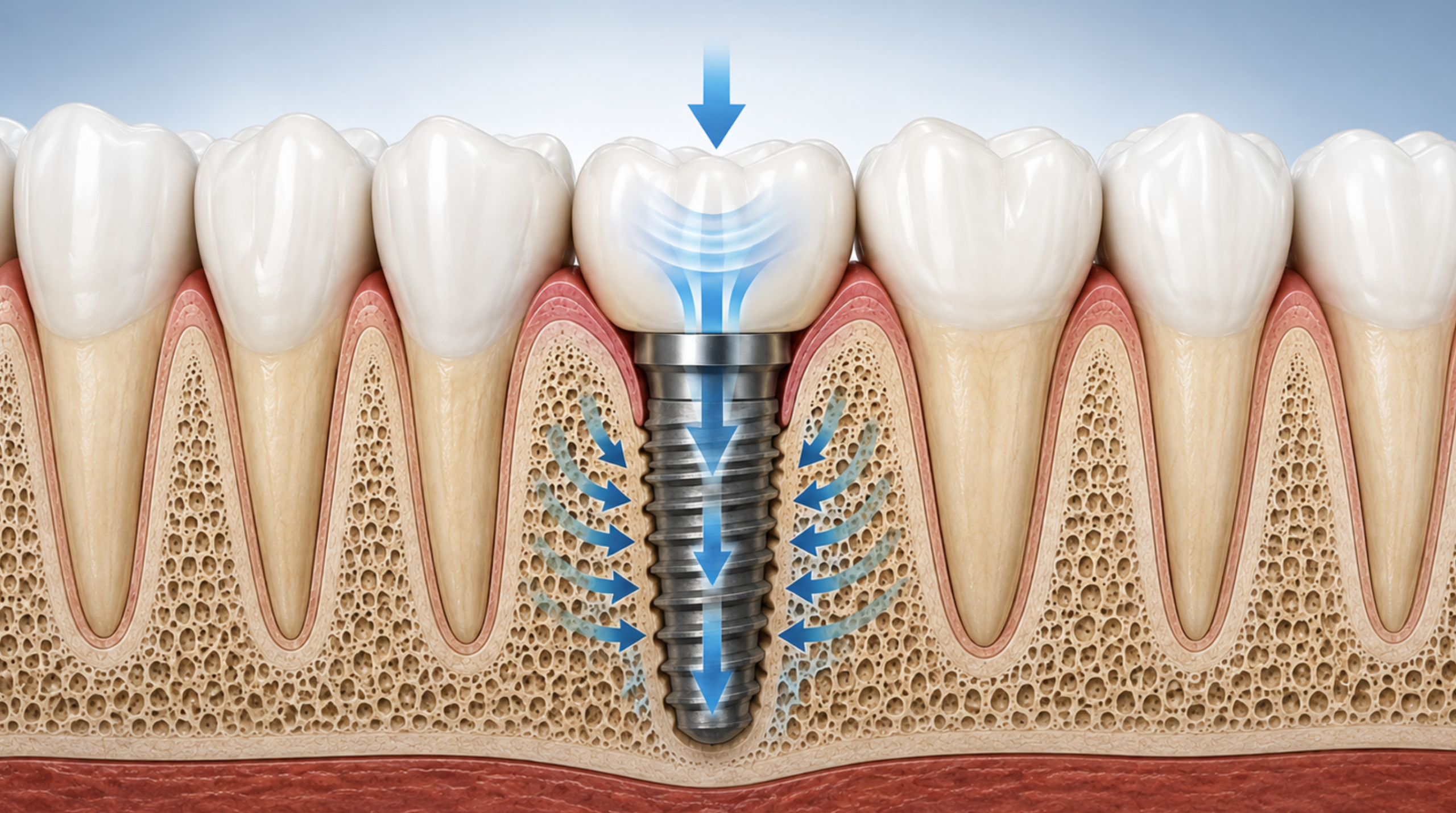
Dental implants restore some of this mechanical stimulation by transferring chewing forces to the surrounding bone. This can help maintain bone around the implants and support the surrounding oral tissues.
Traditional dentures work differently. Because they rest mainly on the gums rather than being anchored in the jawbone, they do not provide the same type of stimulation.
Key point: Dental implants can help maintain bone where they are functioning, but they cannot prevent all changes to the jawbone over time.
Which Lasts Longer: Dentures or Dental Implants?
There is no single lifespan that applies to every denture or dental implant. How long either option lasts depends on the type of restoration, your oral health, daily habits and ongoing care.
For implant-supported restorations, it is important to distinguish between two components:
- the dental implant, which is placed in the jawbone;
- the restoration attached to it, such as a crown, bridge or full-arch prosthesis.
These components can have different lifespans. An implant may remain healthy and functional even if the restoration it supports eventually needs to be adjusted, repaired or replaced.
Factors that can affect longevity include:
- oral hygiene;
- the health of the gums and tissues around the implants;
- smoking;
- overall health;
- teeth grinding or clenching;
- the forces placed on the restoration;
- regular dental follow-up and maintenance.
Traditional dentures can also remain functional for many years. However, the gums and jawbone can change over time, which may affect how the denture fits and lead to the need for adjustments, relining or replacement.
The key question is not only how long a treatment may last, but also what maintenance it may require over time.
What Is All-on-X and How Does It Compare With Dentures?
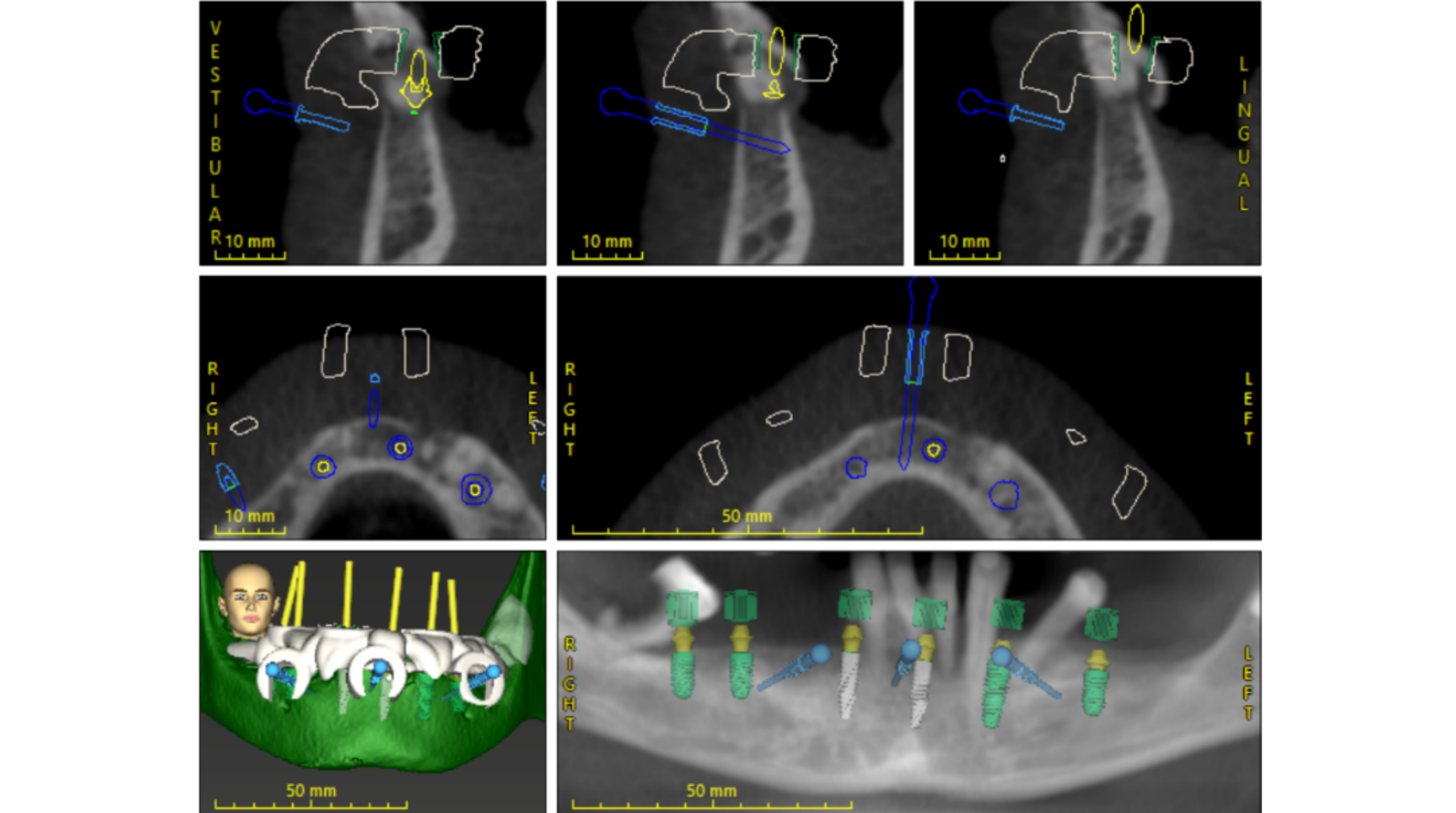
All-on-X is a treatment approach that uses multiple dental implants to support a full arch of replacement teeth.
Rather than placing an implant for every missing tooth, several implants are strategically positioned in the jaw to support the full-arch restoration. The number and position of the implants depend on factors such as your jaw anatomy, available bone and individual treatment needs.
Compared with a traditional denture, All-on-X:
- is supported by dental implants rather than resting on the gums;
- generally provides greater stability when eating and speaking;
- can support a fixed restoration, depending on the treatment plan;
- can replace a full arch of teeth without requiring an implant for every missing tooth.
In brief: A traditional denture is removable and rests on the gums, while All-on-X uses multiple implants to support a full arch of replacement teeth. Depending on your clinical needs, this can provide a fixed and more stable alternative to traditional dentures.
Can Dentures Be Replaced With Dental Implants?
Yes. In many cases, dental implants can be used to replace a traditional denture or provide additional support to make it more stable. However, replacing a denture with implants does not necessarily mean switching to a fixed restoration.
There are both removable and fixed implant-supported options.
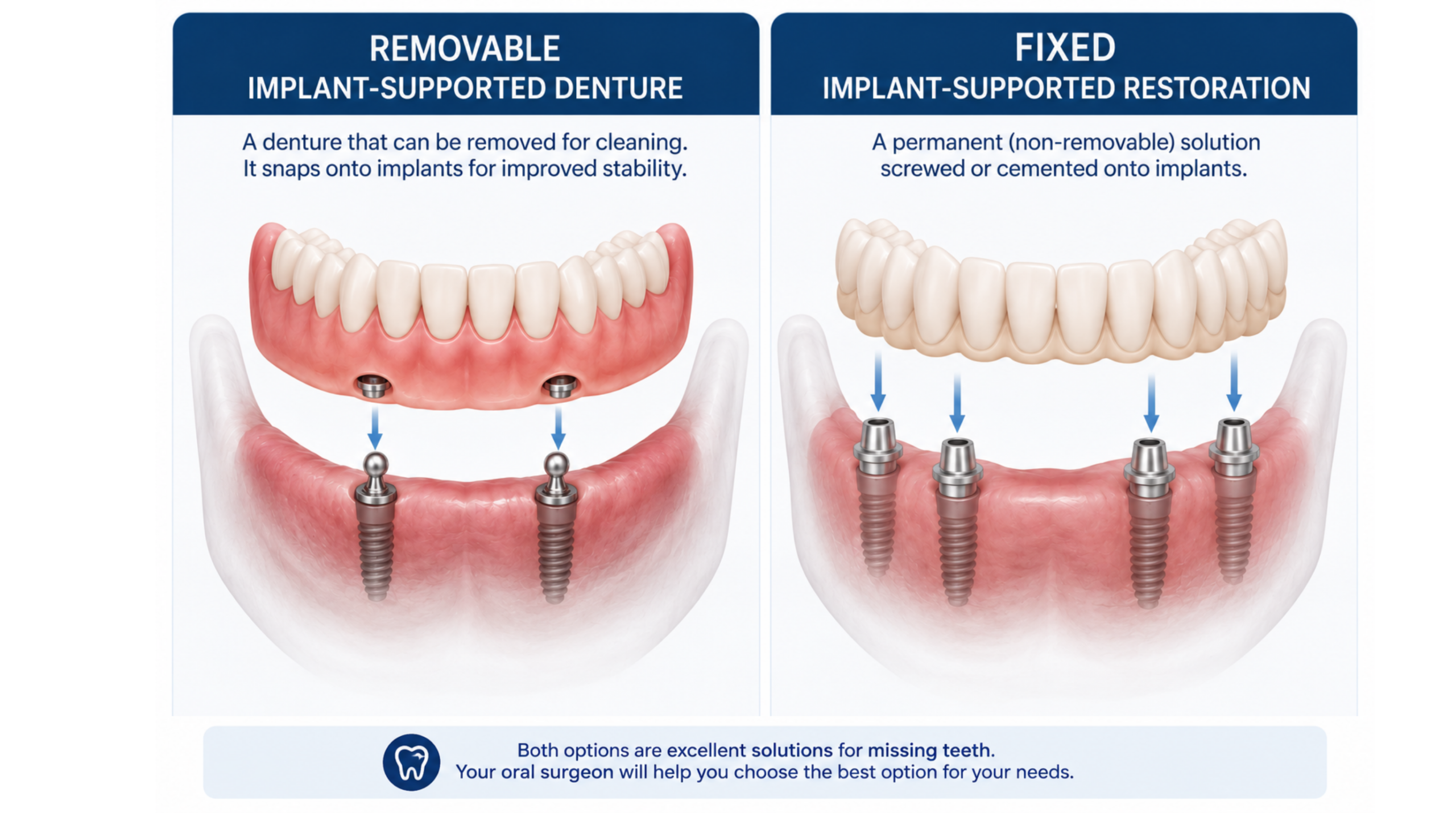
Removable Implant-Supported Denture
An implant-supported denture remains removable, but it attaches to dental implants for added retention and stability.
Compared with a traditional denture, it may provide:
- less movement;
- better retention;
- greater stability while eating;
- easy removal for daily cleaning.
Fixed Implant-Supported Restoration
A fixed restoration is supported by multiple dental implants and is designed to remain in place rather than being removed by the patient each day. All-on-X is one approach that may be considered when replacing a full arch of teeth.
Can You Get Dental Implants After Wearing Dentures for Several Years?
Yes. Wearing dentures for several years does not automatically mean you are no longer a candidate for dental implants.
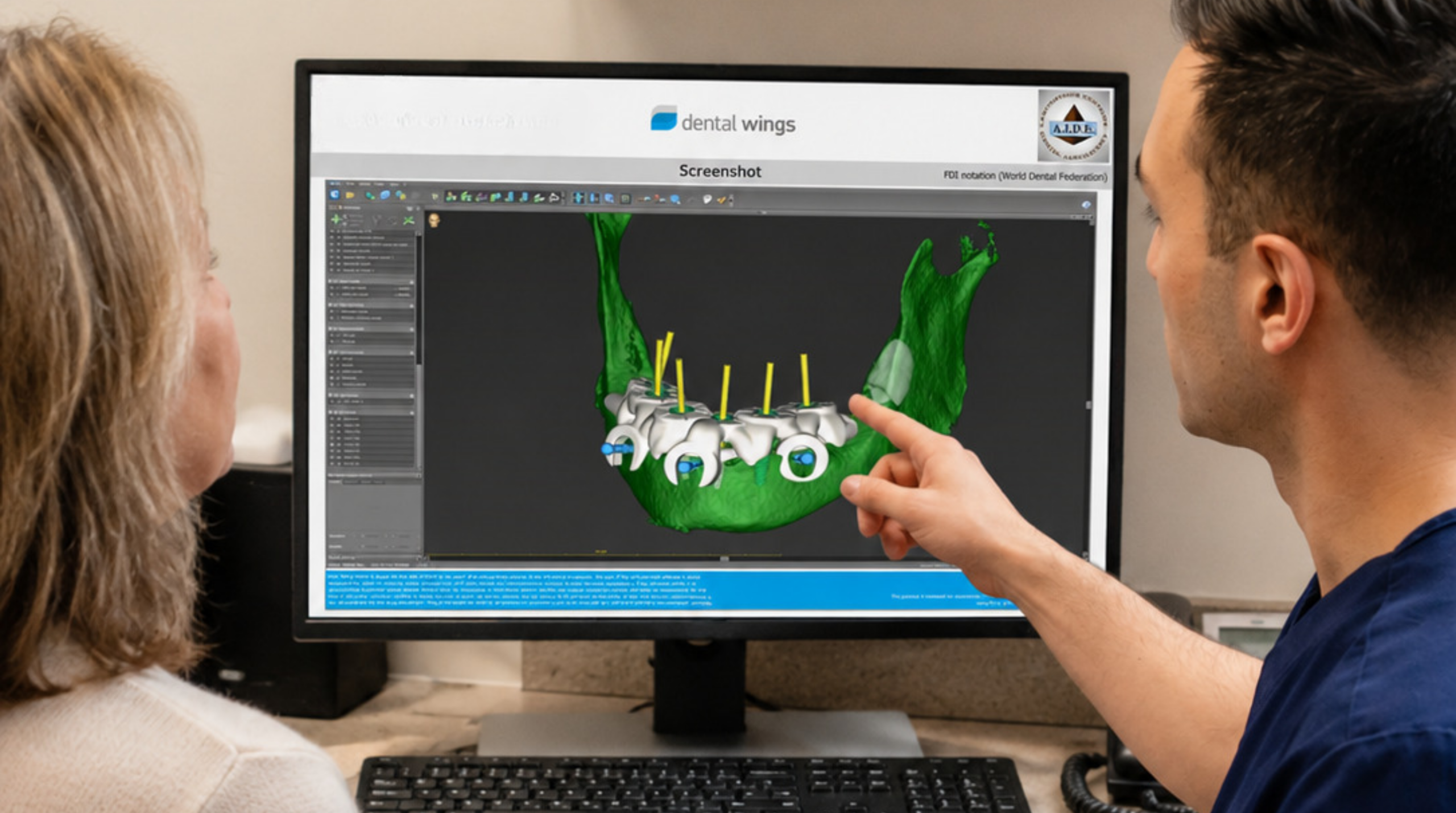
However, the jawbone can change over time after teeth are lost. A personalized evaluation can help determine how much bone is available, assess its condition and identify which treatment options may be appropriate for you.
Your evaluation may include:
- a clinical examination;
- 3D imaging, when indicated;
- an assessment of your bone and gums;
- a review of your medical history and medications;
- your smoking habits;
- your ability to maintain good oral hygiene;
- your goals and whether you prefer a fixed or removable solution.
Even if you have worn dentures for many years, it may not be too late to consider dental implants.
Can You Get Dental Implants If You Don’t Have Enough Bone?
In some cases, yes. Significant bone loss does not necessarily rule out dental implants. The options available depend on where the bone loss has occurred, how extensive it is and your individual anatomy.
Depending on your situation, your oral surgeon may consider:
- adjusting the position of the implants;
- bone grafting in selected cases;
- other reconstructive techniques;
- specialized implants when conventional implants are not suitable.
Zygomatic Implants
Zygomatic implants are designed to anchor in the zygomatic bone, otherwise known as the cheekbone, rather than relying primarily on the upper jawbone for support.
They may be considered for certain patients with significant bone loss in the upper jaw, particularly when there is not enough bone to support conventional dental implants.
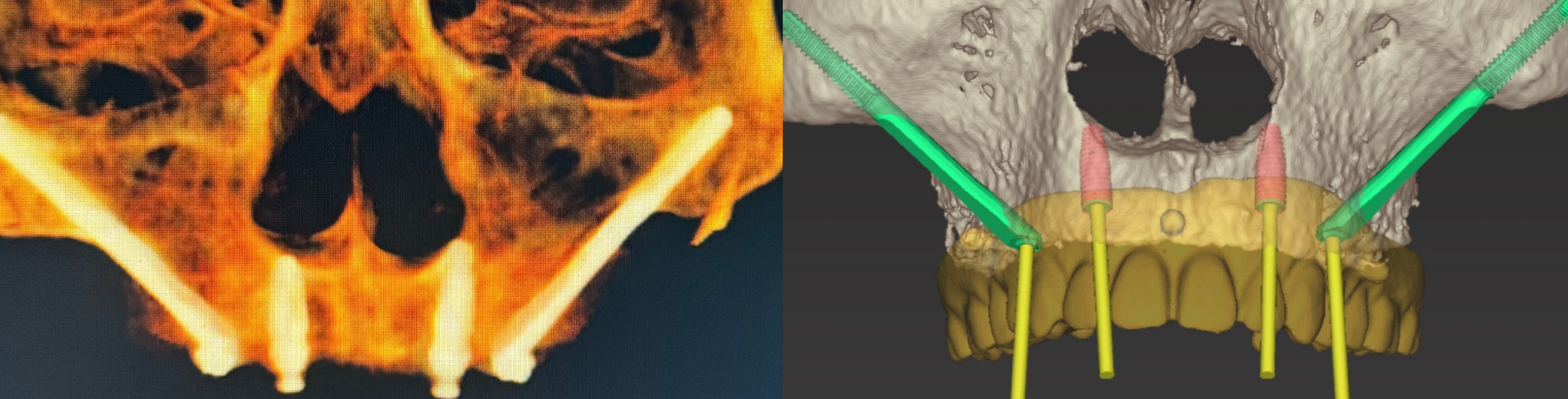
Because this is a complex surgical approach, careful patient selection, detailed treatment planning and specialized training are important. The 2026 international consensus on zygomatic implants also emphasizes the importance of specific training for clinicians performing this procedure.
Seaforth Oral Surgery is a ZAGA Center of Zygomatic Excellence in Montreal, reflecting our dedicated approach to evaluating and treating complex cases involving severe upper jaw bone loss with zygomatic implants.
Dentures or Implants: How Do You Choose the Right Option?
Rather than asking, “Which option is best?”, a more useful question may be: “Which option best suits my needs and priorities?”
Several factors can help determine which treatment may be appropriate for you, including:
- the number of teeth that need to be replaced;
- the amount and quality of available bone;
- your overall and oral health;
- your ability to maintain good oral hygiene;
- whether you prefer a fixed or removable solution;
- your expectations for chewing, comfort and stability;
- your budget;
- your willingness to undergo surgery;
- your long-term treatment goals.
When Might a Traditional Denture Be Appropriate?
A traditional denture may be suitable if you are looking for a removable option that does not require implant surgery and generally has a lower initial cost. It may also be considered when implant surgery is not recommended based on your health or anatomy.
When Might an Implant-Supported Solution Be Considered?
An implant-supported solution may be considered if greater stability and retention are important to you. Because implants are anchored in the jawbone, they can help reduce movement of the prosthesis and, depending on the treatment, may support a fixed restoration.
Implant treatment does require surgery, typically involves a higher initial cost and requires consistent oral hygiene and long-term maintenance.
If stability is a priority, an implant-supported solution generally offers an advantage over a traditional removable denture. Ultimately, the appropriate treatment depends on your anatomy, health, preferences and long-term goals.
When Should You Have a Loose Denture Evaluated?
A loose or unstable denture does not necessarily mean that you need dental implants. However, it may be worth having the fit evaluated if:
- your denture moves while you eat;
- it lifts or shifts when you speak;
- chewing has become more difficult;
- you need to use more denture adhesive than before;
- your gums are frequently irritated or sore;
- you develop recurring areas of pressure or discomfort;
- your denture no longer seems to fit as well as it once did;
- you feel less comfortable eating, speaking or smiling.
In some cases, adjusting or relining the denture may improve its fit. In others, an implant-supported denture or fixed implant restoration may be considered to provide greater stability.
FAQ: Dentures or Dental Implants
Which Is More Stable: Dentures or Dental Implants?
Implant-supported restorations are generally more stable than traditional removable dentures. Dental implants are anchored in the jawbone, while conventional dentures rely mainly on the gums and surrounding oral structures for support.
The degree of stability depends on factors such as the number and position of the implants, the available bone and the type of restoration.
Can Dentures Be Replaced With Dental Implants?
Yes, in many cases. Depending on your needs and anatomy, implants may be used to stabilize a removable denture or support a fixed restoration.
A clinical examination and appropriate imaging are needed to determine which options may be suitable for you.
Can You Get Implants After Wearing Dentures for Several Years?
Yes, it may still be possible to receive dental implants after wearing dentures for many years. Long-term denture use does not automatically prevent you from being a candidate.
However, the amount and quality of available bone need to be assessed before determining the appropriate treatment options.
Is It Easier to Eat With Implants Than With Dentures?
Implant-supported restorations generally move less than traditional dentures, which can provide greater stability when chewing. This may make certain foods easier to eat and help you feel more confident during meals.
Chewing ability varies depending on the type of restoration and your individual clinical situation.
Do Dental Implants Prevent Bone Loss?
Dental implants do not prevent all bone loss. However, when functioning, they transfer chewing forces to the surrounding bone and can help maintain the bone around the implants.
What Is the Difference Between Dentures and All-on-X?
A traditional denture is removable and relies mainly on the gums for support. All-on-X uses multiple dental implants anchored in the jawbone to support a full-arch restoration.
Depending on the treatment plan, an All-on-X restoration may be fixed in place rather than removed by the patient.
How Many Implants Are Needed to Replace All Your Teeth?
There is no single number that is right for every patient. The number and position of implants depend on factors such as the dental arch being treated, your anatomy, the amount of available bone and the type of restoration planned.
Can You Get Dental Implants If You Don’t Have Enough Bone?
In some cases, yes. Depending on the location and extent of bone loss, bone grafting or an alternative implant approach may be considered.
For certain complex cases involving significant bone loss in the upper jaw, zygomatic implants may also be an option.
Are There Dentures That Attach to Dental Implants?
Yes. Implant-supported dentures use dental implants as retention points, helping the denture remain more stable during everyday activities such as eating and speaking.
The denture can still be removed for cleaning but generally moves less than a traditional removable denture.
How Long Do Dental Implants Last?
There is no guaranteed lifespan for a dental implant. Longevity depends on factors such as oral hygiene, the health of the tissues surrounding the implant, lifestyle habits, the forces placed on the restoration and regular professional care.
It is also important to distinguish between the dental implant itself and the prosthetic restoration it supports, as they may have different lifespans.
How Much Do Dentures Cost Compared With Dental Implants?
Traditional dentures generally have a lower initial cost than implant-supported treatment. The cost of dental implant treatment varies depending on the number of implants, the type of restoration, the complexity of surgery, required imaging and whether additional procedures are needed.
Dental Implant Consultation in Montreal
Does your denture move when you eat or speak? Are you wondering whether an implant-supported denture, a fixed restoration or another treatment option could provide greater stability?
The team at Seaforth Oral Surgery in Montreal can assess your oral health, jaw anatomy and available bone to determine which treatment options may be appropriate for you.
Depending on your needs, options may include an implant-supported denture, a full-arch All-on-X restoration or, in certain complex cases involving significant bone loss in the upper jaw, zygomatic implants.
A denture that shifts when you eat or speak can affect both comfort and confidence in everyday life. If you have lost several or all of your teeth, you may be wondering which option offers greater long-term stability: traditional dentures or dental implants?
In general, implant-supported restorations provide greater stability than traditional removable dentures. While dentures rely mainly on the gums and surrounding oral structures for support, dental implants are anchored directly in the jawbone, creating a more stable foundation for the restoration.
Over time, this added support can mean less movement, more predictable chewing and a feel that is closer to natural fixed teeth. However, dental implants require surgery and may not be suitable for everyone. The best option depends on factors such as your oral health, jaw anatomy, available bone and treatment goals.
What Is the Difference Between Dentures and Dental Implants?
The main difference between dentures and dental implants is how they are supported.
A traditional denture is a removable dental prosthesis used to replace several teeth or all the teeth in an arch. It rests mainly on the gums and other tissues in the mouth.
A traditional denture can:
- be removed by the patient;
- replace several teeth or a full arch of teeth;
- avoid the need for implant surgery;
- require adjustments or relining over time;
- move to some degree while eating or speaking.
A dental implant, by comparison, is an artificial tooth root, usually made of titanium, that is surgically placed in the jawbone. Rather than replacing the visible tooth itself, the implant acts as an anchor for a dental restoration.
One or more implants can support:
- a single crown;
- a dental bridge;
- a removable implant-supported denture;
- a fixed implant-supported restoration;
- a full-arch All-on-X restoration.
After an implant is placed, the surrounding bone gradually heals and integrates with its surface. This process, called osseointegration, helps create a stable foundation for the restoration.
Key point: Traditional dentures rely mainly on the gums for support, while implant-supported restorations are anchored in the jawbone.
Dentures or Implants: Which Option Is More Stable?
For long-term stability, implant-supported restorations generally offer an advantage over traditional dentures.
Because implants are anchored in the jawbone, they provide a stable foundation for the restoration during biting and chewing. For patients who have lost all their teeth, research has also found improvements in oral function and patient-reported outcomes with implant-supported restorations compared with conventional complete dentures.
Depending on the type of restoration, implants can:
- reduce movement while eating or speaking;
- improve retention;
- provide more predictable chewing;
- reduce or eliminate the need for denture adhesives;
- support a fixed restoration in certain cases.
Why Can Dentures Become Loose Over Time?
A denture that once fit comfortably may become looser over the years because the shape of your mouth can change after tooth loss.
Without tooth roots, the jawbone in the area gradually remodels and can decrease in volume. These changes can alter the shape of the ridge and gums that support the denture, affecting how securely it fits.
Over time, you may notice:
- more movement while eating or speaking;
- reduced retention;
- a greater need for denture adhesive;
- gum irritation or pressure points;
- changes in the overall fit of the denture.
When this happens, an adjustment, reline or, eventually, a replacement denture may be recommended.
Not every denture will become significantly unstable. With a well-fitting prosthesis and regular dental follow-up, dentures can remain a functional option for many years.
Dentures vs. Dental Implants: A Long-Term Comparison
Dentures and implant-supported restorations differ in several ways that can affect comfort, function and long-term care.
| Criterion | Traditional Denture | Implant-Supported Restoration |
| Stability | May move during everyday use | Offers greater stability |
| Support | Rests mainly on the gums and oral tissues | Anchored to implants in the jawbone |
| Type of restoration | Removable | Can be removable or fixed |
| Chewing | May require more adaptation | Provides greater stability when chewing |
| Effect on bone | Does not provide the same stimulation as a tooth root | Helps preserve bone around functioning implants |
| Surgery | Generally not required | Requires surgical implant placement |
| Initial cost | Generally lower | Generally higher |
| Maintenance | Daily cleaning; adjustments or relining may be needed | Daily hygiene and ongoing prosthetic maintenance |
| Professional follow-up | Regular follow-up required | Regular follow-up required |
Neither option is maintenance-free. For implant-supported restorations, the health of the tissues surrounding the implants is also important for long-term success. Ultimately, the most appropriate option depends on your oral health, anatomy, needs and treatment goals.
Which Option Makes It Easier to Eat: Dentures or Implants?
Implant-supported restorations generally provide more predictable chewing than traditional removable dentures.
Because removable dentures can shift under pressure, some patients may need to modify how they bite or limit foods that are particularly hard, sticky or difficult to chew.
Implant-supported restorations offer:
- less movement while eating;
- improved retention;
- more predictable chewing;
- greater confidence during meals.
Can Dental Implants Help Preserve Jawbone?
Yes. Dental implants can help maintain the jawbone around them, although some bone changes can still occur over time.
Natural tooth roots transfer chewing forces to the jawbone, providing stimulation that helps maintain the surrounding bone. When teeth are lost, this stimulation decreases and the bone that once supported them will gradually shrink or resorb.
Dental implants restore some of this mechanical stimulation by transferring chewing forces to the surrounding bone. This can help maintain bone around the implants and support the surrounding oral tissues.
Traditional dentures work differently. Because they rest mainly on the gums rather than being anchored in the jawbone, they do not provide the same type of stimulation.
Key point: Dental implants can help maintain bone where they are functioning, but they cannot prevent all changes to the jawbone over time.
Which Lasts Longer: Dentures or Dental Implants?
There is no single lifespan that applies to every denture or dental implant. How long either option lasts depends on the type of restoration, your oral health, daily habits and ongoing care.
For implant-supported restorations, it is important to distinguish between two components:
- the dental implant, which is placed in the jawbone;
- the restoration attached to it, such as a crown, bridge or full-arch prosthesis.
These components can have different lifespans. An implant may remain healthy and functional even if the restoration it supports eventually needs to be adjusted, repaired or replaced.
Factors that can affect longevity include:
- oral hygiene;
- the health of the gums and tissues around the implants;
- smoking;
- overall health;
- teeth grinding or clenching;
- the forces placed on the restoration;
- regular dental follow-up and maintenance.
Traditional dentures can also remain functional for many years. However, the gums and jawbone can change over time, which may affect how the denture fits and lead to the need for adjustments, relining or replacement.
The key question is not only how long a treatment may last, but also what maintenance it may require over time.
What Is All-on-X and How Does It Compare With Dentures?
All-on-X is a treatment approach that uses multiple dental implants to support a full arch of replacement teeth.
Rather than placing an implant for every missing tooth, several implants are strategically positioned in the jaw to support the full-arch restoration. The number and position of the implants depend on factors such as your jaw anatomy, available bone and individual treatment needs.
Compared with a traditional denture, All-on-X:
- is supported by dental implants rather than resting on the gums;
- generally provides greater stability when eating and speaking;
- can support a fixed restoration, depending on the treatment plan;
- can replace a full arch of teeth without requiring an implant for every missing tooth.
In brief: A traditional denture is removable and rests on the gums, while All-on-X uses multiple implants to support a full arch of replacement teeth. Depending on your clinical needs, this can provide a fixed and more stable alternative to traditional dentures.
Can Dentures Be Replaced With Dental Implants?
Yes. In many cases, dental implants can be used to replace a traditional denture or provide additional support to make it more stable. However, replacing a denture with implants does not necessarily mean switching to a fixed restoration.
There are both removable and fixed implant-supported options.
Removable Implant-Supported Denture
An implant-supported denture remains removable, but it attaches to dental implants for added retention and stability.
Compared with a traditional denture, it may provide:
- less movement;
- better retention;
- greater stability while eating;
- easy removal for daily cleaning.
Fixed Implant-Supported Restoration
A fixed restoration is supported by multiple dental implants and is designed to remain in place rather than being removed by the patient each day. All-on-X is one approach that may be considered when replacing a full arch of teeth.
Can You Get Dental Implants After Wearing Dentures for Several Years?
Yes. Wearing dentures for several years does not automatically mean you are no longer a candidate for dental implants.
However, the jawbone can change over time after teeth are lost. A personalized evaluation can help determine how much bone is available, assess its condition and identify which treatment options may be appropriate for you.
Your evaluation may include:
- a clinical examination;
- 3D imaging, when indicated;
- an assessment of your bone and gums;
- a review of your medical history and medications;
- your smoking habits;
- your ability to maintain good oral hygiene;
- your goals and whether you prefer a fixed or removable solution.
Even if you have worn dentures for many years, it may not be too late to consider dental implants.
Can You Get Dental Implants If You Don’t Have Enough Bone?
In some cases, yes. Significant bone loss does not necessarily rule out dental implants. The options available depend on where the bone loss has occurred, how extensive it is and your individual anatomy.
Depending on your situation, your oral surgeon may consider:
- adjusting the position of the implants;
- bone grafting in selected cases;
- other reconstructive techniques;
- specialized implants when conventional implants are not suitable.
Zygomatic Implants
Zygomatic implants are designed to anchor in the zygomatic bone, otherwise known as the cheekbone, rather than relying primarily on the upper jawbone for support.
They may be considered for certain patients with significant bone loss in the upper jaw, particularly when there is not enough bone to support conventional dental implants.
Because this is a complex surgical approach, careful patient selection, detailed treatment planning and specialized training are important. The 2026 international consensus on zygomatic implants also emphasizes the importance of specific training for clinicians performing this procedure.
Seaforth Oral Surgery is a ZAGA Center of Zygomatic Excellence in Montreal, reflecting our dedicated approach to evaluating and treating complex cases involving severe upper jaw bone loss with zygomatic implants.
Dentures or Implants: How Do You Choose the Right Option?
Rather than asking, “Which option is best?”, a more useful question may be: “Which option best suits my needs and priorities?”
Several factors can help determine which treatment may be appropriate for you, including:
- the number of teeth that need to be replaced;
- the amount and quality of available bone;
- your overall and oral health;
- your ability to maintain good oral hygiene;
- whether you prefer a fixed or removable solution;
- your expectations for chewing, comfort and stability;
- your budget;
- your willingness to undergo surgery;
- your long-term treatment goals.
When Might a Traditional Denture Be Appropriate?
A traditional denture may be suitable if you are looking for a removable option that does not require implant surgery and generally has a lower initial cost. It may also be considered when implant surgery is not recommended based on your health or anatomy.
When Might an Implant-Supported Solution Be Considered?
An implant-supported solution may be considered if greater stability and retention are important to you. Because implants are anchored in the jawbone, they can help reduce movement of the prosthesis and, depending on the treatment, may support a fixed restoration.
Implant treatment does require surgery, typically involves a higher initial cost and requires consistent oral hygiene and long-term maintenance.
If stability is a priority, an implant-supported solution generally offers an advantage over a traditional removable denture. Ultimately, the appropriate treatment depends on your anatomy, health, preferences and long-term goals.
When Should You Have a Loose Denture Evaluated?
A loose or unstable denture does not necessarily mean that you need dental implants. However, it may be worth having the fit evaluated if:
- your denture moves while you eat;
- it lifts or shifts when you speak;
- chewing has become more difficult;
- you need to use more denture adhesive than before;
- your gums are frequently irritated or sore;
- you develop recurring areas of pressure or discomfort;
- your denture no longer seems to fit as well as it once did;
- you feel less comfortable eating, speaking or smiling.
In some cases, adjusting or relining the denture may improve its fit. In others, an implant-supported denture or fixed implant restoration may be considered to provide greater stability.
FAQ: Dentures or Dental Implants
Which Is More Stable: Dentures or Dental Implants?
Implant-supported restorations are generally more stable than traditional removable dentures. Dental implants are anchored in the jawbone, while conventional dentures rely mainly on the gums and surrounding oral structures for support.
The degree of stability depends on factors such as the number and position of the implants, the available bone and the type of restoration.
Can Dentures Be Replaced With Dental Implants?
Yes, in many cases. Depending on your needs and anatomy, implants may be used to stabilize a removable denture or support a fixed restoration.
A clinical examination and appropriate imaging are needed to determine which options may be suitable for you.
Can You Get Implants After Wearing Dentures for Several Years?
Yes, it may still be possible to receive dental implants after wearing dentures for many years. Long-term denture use does not automatically prevent you from being a candidate.
However, the amount and quality of available bone need to be assessed before determining the appropriate treatment options.
Is It Easier to Eat With Implants Than With Dentures?
Implant-supported restorations generally move less than traditional dentures, which can provide greater stability when chewing. This may make certain foods easier to eat and help you feel more confident during meals.
Chewing ability varies depending on the type of restoration and your individual clinical situation.
Do Dental Implants Prevent Bone Loss?
Dental implants do not prevent all bone loss. However, when functioning, they transfer chewing forces to the surrounding bone and can help maintain the bone around the implants.
What Is the Difference Between Dentures and All-on-X?
A traditional denture is removable and relies mainly on the gums for support. All-on-X uses multiple dental implants anchored in the jawbone to support a full-arch restoration.
Depending on the treatment plan, an All-on-X restoration may be fixed in place rather than removed by the patient.
How Many Implants Are Needed to Replace All Your Teeth?
There is no single number that is right for every patient. The number and position of implants depend on factors such as the dental arch being treated, your anatomy, the amount of available bone and the type of restoration planned.
Can You Get Dental Implants If You Don’t Have Enough Bone?
In some cases, yes. Depending on the location and extent of bone loss, bone grafting or an alternative implant approach may be considered.
For certain complex cases involving significant bone loss in the upper jaw, zygomatic implants may also be an option.
Are There Dentures That Attach to Dental Implants?
Yes. Implant-supported dentures use dental implants as retention points, helping the denture remain more stable during everyday activities such as eating and speaking.
The denture can still be removed for cleaning but generally moves less than a traditional removable denture.
How Long Do Dental Implants Last?
There is no guaranteed lifespan for a dental implant. Longevity depends on factors such as oral hygiene, the health of the tissues surrounding the implant, lifestyle habits, the forces placed on the restoration and regular professional care.
It is also important to distinguish between the dental implant itself and the prosthetic restoration it supports, as they may have different lifespans.
How Much Do Dentures Cost Compared With Dental Implants?
Traditional dentures generally have a lower initial cost than implant-supported treatment. The cost of dental implant treatment varies depending on the number of implants, the type of restoration, the complexity of surgery, required imaging and whether additional procedures are needed.
Dental Implant Consultation in Montreal
Does your denture move when you eat or speak? Are you wondering whether an implant-supported denture, a fixed restoration or another treatment option could provide greater stability?
The team at Seaforth Oral Surgery in Montreal can assess your oral health, jaw anatomy and available bone to determine which treatment options may be appropriate for you.
Depending on your needs, options may include an implant-supported denture, a full-arch All-on-X restoration or, in certain complex cases involving significant bone loss in the upper jaw, zygomatic implants.