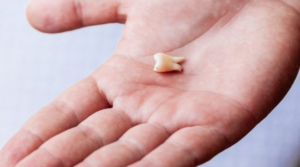
Losing a tooth does not always cause pain or immediate symptoms. However, once a tooth is lost, gradual changes can occur, including bone loss, shifting of the neighbouring teeth, changes in your bite, and difficulty chewing.
The best time to replace a tooth varies from one patient to another. However, an early assessment can help you better understand the risks, preserve more treatment options, and, in some cases, simplify treatment.
Quick answer:
It may be possible to wait before replacing a missing tooth, but it is best to seek an assessment sooner rather than later. The longer the tooth remains missing, the more bone loss, shifting of the neighbouring teeth, and changes in your bite can make replacement more complex.
At a Glance
- A missing tooth can cause changes without causing pain.
- The bone that supported the tooth root naturally begins to remodel.
- Neighbouring teeth may shift into the open space.
- There is no single ideal timeline that applies to everyone.
- Seeking an early assessment does not necessarily mean receiving an implant right away.
- Even after several years, treatment options are often still available.
What Happens When a Tooth Is Lost?
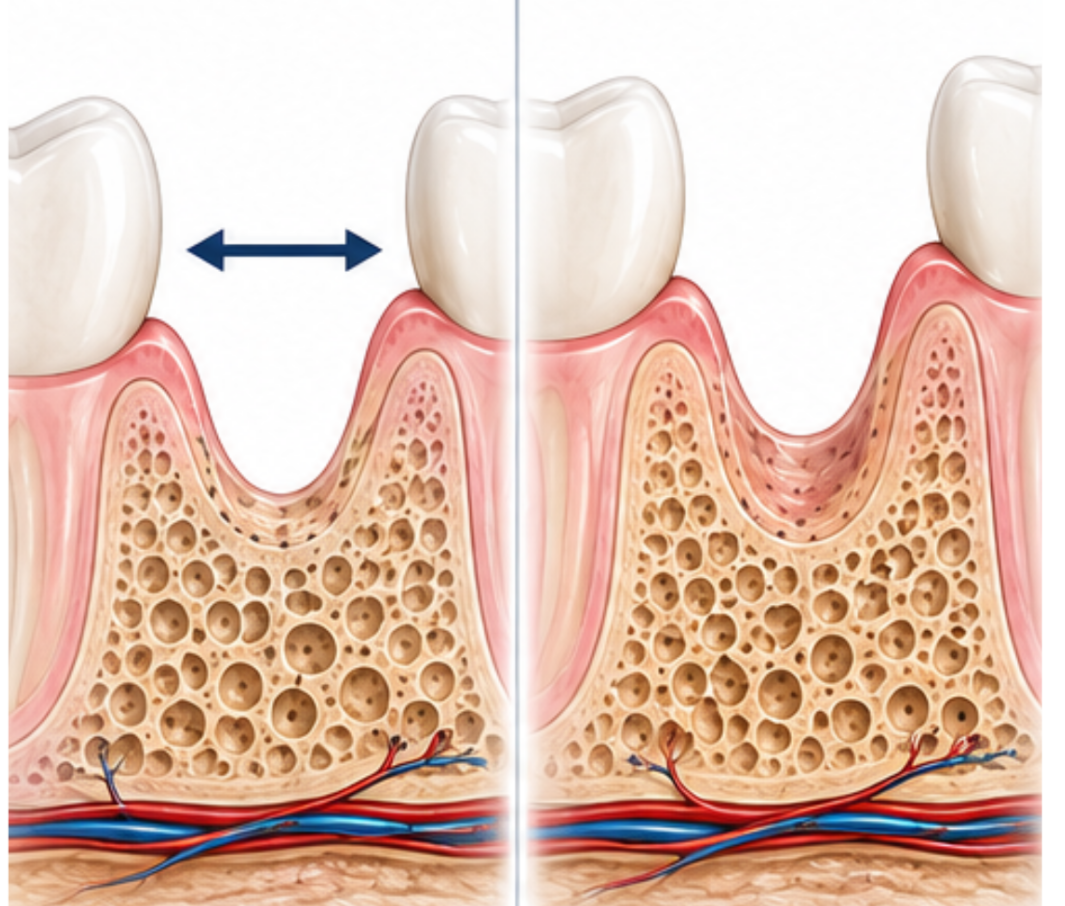
Losing a tooth affects more than the appearance of your smile. It can also affect the jawbone, the position of the other teeth, and the balance of your bite and chewing function.
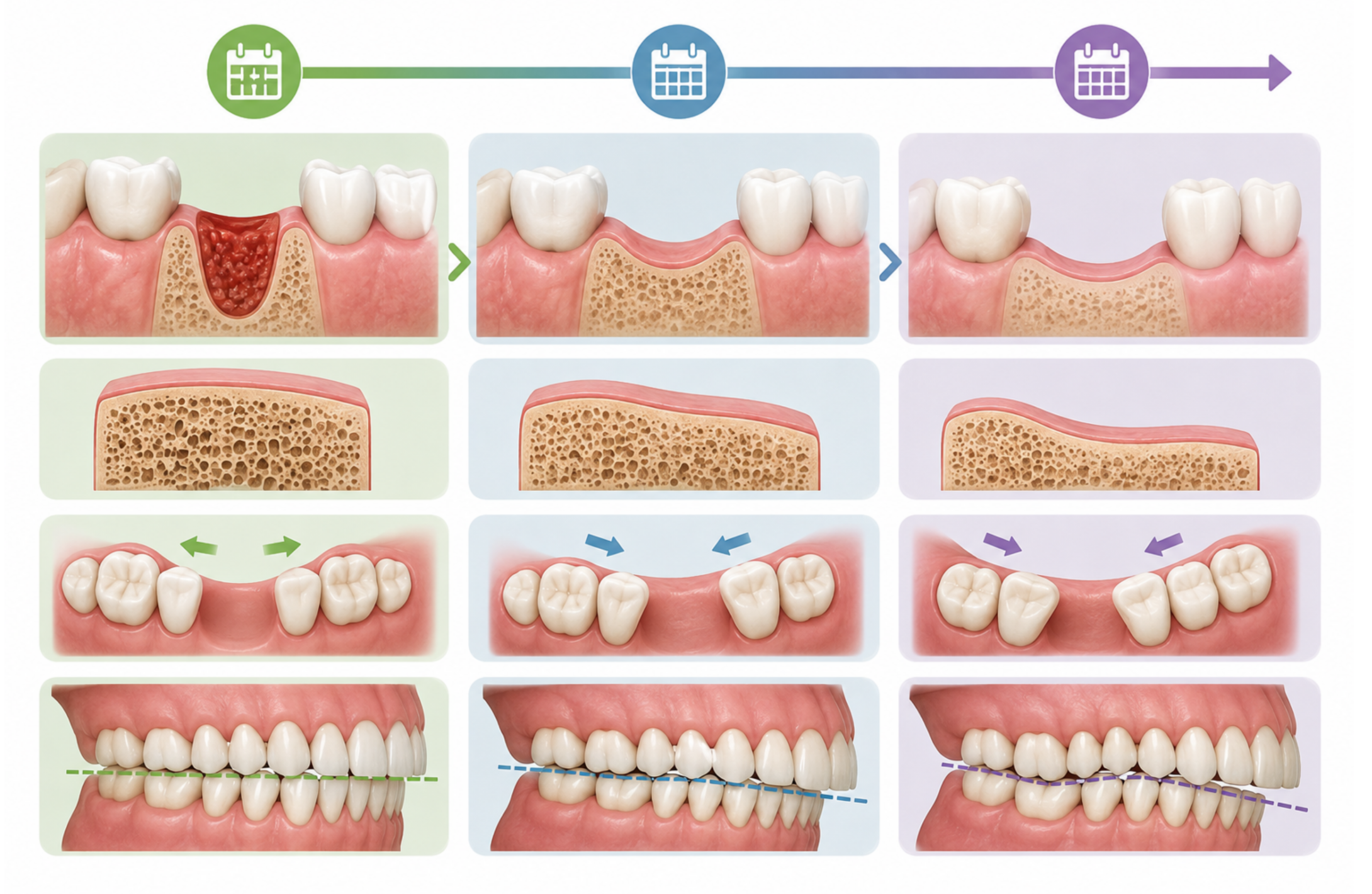
A tooth root transfers chewing forces to the surrounding bone. When the tooth is no longer present, this stimulation disappears. The alveolar bone—the bone that supported the root—then begins to remodel and gradually decreases in height and width.
This process is known as bone resorption. It can occur without pain or visible signs. This is why the absence of symptoms does not necessarily mean that your mouth remains unchanged.
What Are the Possible Consequences of a Missing Tooth?
Depending on the tooth involved and your individual situation, a missing tooth may lead to:
- a gradual decrease in bone volume;
- shifting or tilting of the neighbouring teeth;
- over-eruption of the opposing tooth;
- a change in your bite, meaning the way your teeth meet;
- less efficient or less balanced chewing;
- insufficient space for a future replacement tooth;
- a replacement procedure that may become more complex.
The teeth surrounding the open space can shift and change the way chewing forces are distributed.
Key Point
After a tooth is lost, the surrounding bone and teeth may gradually change, even if you do not feel any pain. These changes can affect the replacement options available later.
How Long Can You Wait Before Replacing a Tooth?
There is no universal timeline.
Some people maintain favourable bone volume and adequate space for a long time. In others, bone resorption or tooth movement progresses more quickly.
The best time to seek an assessment is generally before significant changes occur, even if the permanent replacement is not completed right away.
| Time Elapsed | Possible Changes |
| A few weeks | The gums heal and bone resorption begins. |
| A few months | Bone volume has decreased, and some teeth may begin to shift. |
| Several years | Bone loss, narrowing of the space, and changes in the bite may become more noticeable. |
This timeline illustrates a possible progression. It is not a precise schedule that applies to every patient.
The First Few Weeks and Months
After an extraction, the gums and bone go through a normal healing period. An early assessment can help determine:
- whether immediate implant placement may be possible;
- whether it would be better to wait for partial or complete healing;
- whether socket preservation may be recommended;
- whether a temporary tooth is needed;
- when the permanent treatment should ideally take place.
Implant treatment protocols may involve immediate placement on the day of extraction, early placement after a healing period, or delayed placement once the bone has fully healed. The appropriate approach depends on the treatment site and the individual patient.
After Several Months or Years
When a tooth has been missing for a long time, the assessment may reveal:
- reduced bone volume;
- less available space because the neighbouring teeth have shifted;
- changes in the bite;
- a need for orthodontic correction;
- a possible need for bone grafting;
- more complex surgical and restorative planning.
This does not mean that it is too late. Many patients can still receive an implant or another replacement option after many years.
Quick Answer
The longer a tooth remains missing, the more changes in the bone, available space, and tooth alignment can complicate its replacement. An early assessment helps preserve a wider range of treatment options.
Is a Missing Tooth an Emergency?
A tooth that has been missing for some time is generally not a medical emergency. However, you should not wait until you experience pain or difficulty chewing before requesting an assessment.
Seek care more quickly when recent tooth loss is accompanied by:
- bleeding that does not stop;
- significant trauma;
- severe pain;
- pronounced swelling;
- fever;
- drainage or other possible signs of infection.
A permanent tooth that has been completely knocked out in an accident is a different situation. Contact a dental professional immediately, as prompt treatment may be necessary.
What Factors Affect the Timing of Tooth Replacement?
The Location of the Tooth
A front tooth contributes to the appearance of your smile, speech, and lip support. Its replacement is often planned promptly for both aesthetic and functional reasons.
A premolar or molar is less visible, but it plays an important role in chewing and distributing forces. Its absence can therefore have consequences even if it is not noticeable when you smile.
Bone Volume and Quality
An implant must be placed in enough bone to achieve good stability.
When too much bone volume has been lost, a graft may sometimes be recommended before or during implant placement. However, grafting is not necessary for every patient. A clinical and radiographic assessment can be used to evaluate the height, width, and density of the available bone.
The Health of the Teeth and Gums
The treatment plan also takes into account:
- active gum disease;
- infection at the tooth site;
- your oral hygiene;
- smoking or vaping;
- diabetes and how well it is controlled;
- certain medications or health conditions;
- jaw growth in younger patients.
The Replacement Option Being Considered
The ideal timing is not necessarily the same for an implant, a bridge, or a removable partial denture.
Each option has different requirements related to bone, gums, available space, and the health of the neighbouring teeth. Treatment should therefore be selected based on your mouth as a whole, not only the empty space.
Why Should You Seek an Assessment Sooner Rather Than Later?
Receiving care at the right time may help:
- preserve more bone volume;
- limit shifting of the neighbouring teeth;
- maintain enough space for the future restoration;
- preserve a more stable bite;
- support balanced chewing;
- reduce the complexity of certain procedures;
- reduce, in some cases, the extent of bone reconstruction required.
Seeking an early assessment does not mean that an implant must be placed immediately. The goal is to evaluate the situation while several options are still available.
Quick Answer
An early assessment may help preserve bone volume, the space between the teeth, and balanced chewing. It also allows the most appropriate time for treatment to be selected, even if permanent treatment needs to be postponed.
Can an Implant Be Placed Immediately After an Extraction?
Yes. In some cases, an immediate dental implant after extraction can be placed in the socket on the same day the tooth is removed.
However, this approach is not suitable for every patient. Whether it is possible depends on factors such as:
- the quantity and quality of the bone;
- the integrity of the socket walls;
- whether good implant stability can be achieved;
- the health of the gums;
- the presence and extent of infection;
- the position of the tooth;
- the aesthetic requirements of the treatment area.
Immediate implant placement is a complex procedure that requires careful patient selection and appropriate experience in implant surgery and restoration.
Are the Implant and Tooth Placed on the Same Day?
Not necessarily.
Implant placement refers to inserting the artificial tooth root into the bone. Loading refers to placing a restoration that can receive chewing forces.
An implant may therefore be placed immediately without a permanent crown being installed on the same day. In some cases, a temporary tooth may be used during healing.
What If the Tooth Has Been Missing for Several Years?
It is common to believe that waiting a long time automatically makes dental implants impossible. This is not necessarily the case.
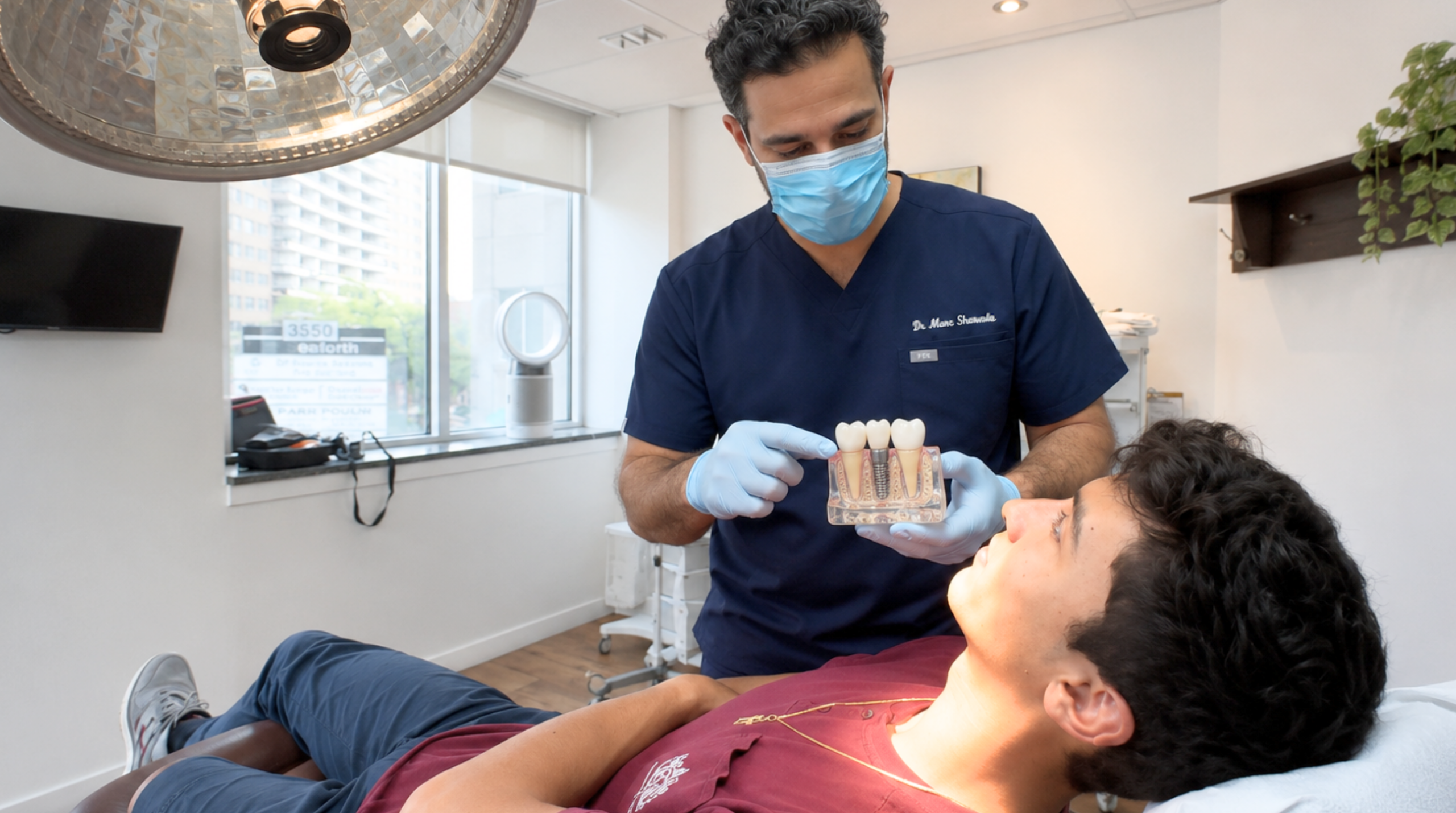
The assessment usually includes a clinical examination and imaging to evaluate:
- the available bone volume;
- the position of the sinuses and nerves;
- the space between the teeth;
- the condition of the neighbouring teeth;
- the health of the gums;
- the relationship between the upper and lower jaws.
Depending on the findings, different approaches may be considered:
- a conventional dental implant;
- bone grafting;
- a sinus lift;
- an implant-supported bridge;
- a full-arch implant restoration.
When severe bone loss is present in the upper jaw, zygomatic implants may be considered for certain patients. These implants are anchored in the cheekbone rather than in an upper jaw ridge that no longer provides enough bone volume.
What Are the Options for Replacing a Missing Tooth?
Dental Implant
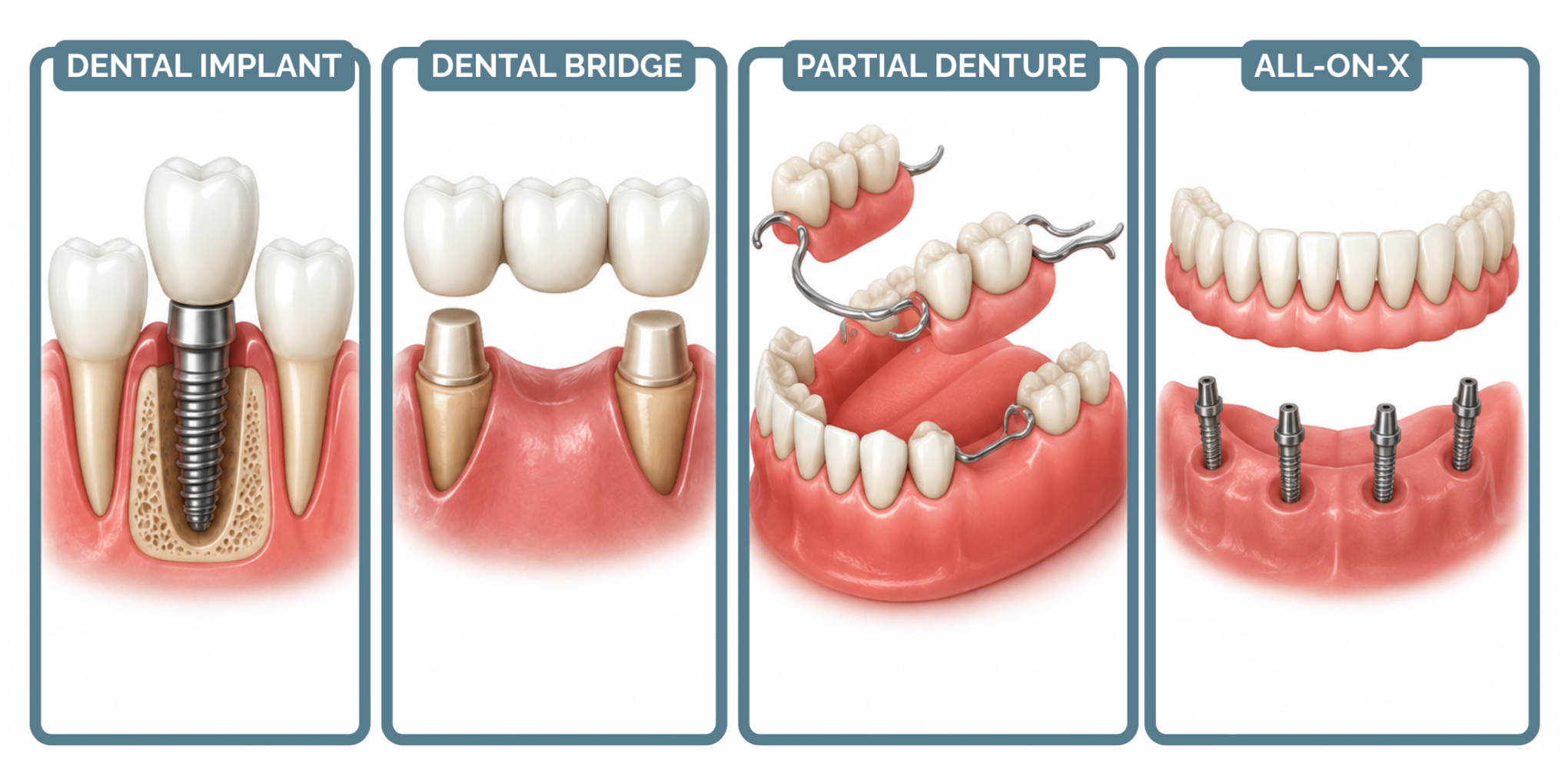
A dental implant is an artificial tooth root inserted into the jawbone. A crown is then attached to the implant to replace the visible portion of the tooth.
This option can:
- replace a tooth without relying on the neighbouring teeth;
- provide a fixed restoration;
- help transfer chewing forces to the bone;
- restore more balanced chewing;
- preserve the integrity of healthy neighbouring teeth.
Dental implants require appropriate bone volume, healthy gums, and regular maintenance.
Dental Bridge
A fixed bridge replaces one or more teeth using an artificial tooth supported by the neighbouring teeth or by implants.
It may be considered when the adjacent teeth already need crowns, mainly because conventional dental bridges require the supporting teeth to be shaven down.
Removable Partial Denture
A partial denture can replace one or more teeth. As the name suggests, it can be removed for cleaning.
It may be a temporary or permanent option depending on the number of missing teeth, your oral health, your preferences, and your budget.
All-on-X (or All-on-4) Treatment
All-on-X treatment is not used to replace a single tooth. It is intended for patients who have lost all the teeth in one arch or whose remaining teeth can no longer be preserved.
This type of full-arch prosthesis, whether fixed or removable, is anchored by strategically positioned dental implants.
Zygomatic Implants
Zygomatic implants are reserved for certain complex cases involving severe bone loss in the upper jaw.
They may offer an option for patients who are not candidates for conventional dental implants or who would otherwise require extensive bone reconstruction.
Does a Missing Tooth Always Need to Be Replaced?
No. In some situations, replacement may be unnecessary or may be postponed with professional monitoring.
The decision depends on factors such as:
- which tooth is missing;
- its role in chewing;
- the stability of your bite;
- the condition of the other teeth;
- your age and jaw growth;
- your general health;
- your functional and aesthetic goals.
An extracted wisdom tooth, for example, generally does not need to be replaced. For another tooth, a personalized assessment can determine whether it is best to monitor the space, close it with orthodontic treatment, or replace the tooth.
What Are the Signs That You Should No Longer Wait?
Book an appointment if you notice:
- difficulty chewing on one side;
- food collecting in the open space;
- a neighbouring tooth that appears to be tilting or shifting;
- an area that is becoming narrower;
- a change in the way your teeth meet;
- jaw pain or fatigue;
- a denture that has become unstable;
- a growing aesthetic or functional concern.
It is also appropriate to seek an assessment even if you do not have symptoms, particularly if you are considering a dental implant.
FAQ – Frequently Asked Questions
How Long Can You Live With a Missing Tooth?
You may be able to live with a missing tooth for several years, but this does not mean that your mouth will remain unchanged. Bone volume may decrease, and the neighbouring teeth may shift. An assessment can help estimate the risks in your particular situation.
Is It Serious Not to Replace a Tooth?
Not always in the short term. Over time, however, a missing tooth can affect the bone, tooth alignment, bite, and chewing. The extent of these changes depends on the tooth involved and your oral health.
Do You Lose Bone After a Tooth Extraction?
Yes. After an extraction, the bone that surrounded the root naturally remodels, decreasing in height and width. The amount and speed of this resorption vary depending on the patient and the location of the tooth.
Can a Missing Tooth Cause the Other Teeth to Shift?
Yes. The neighbouring teeth may tilt or migrate into the open space. The opposing tooth may also over-erupt when it no longer has contact with a tooth in the opposite arch.
How Long After an Extraction Can an Implant Be Placed?
An implant may be placed on the day of extraction, after a few weeks, after a few months, or once the bone has completely healed. The right timing depends on the condition of the socket, bone volume, gum health, and the possible presence of infection.
Is It Too Late to Get an Implant After Several Years?
Not necessarily. Many patients can still receive an implant after a long period. However, bone grafting or another treatment approach may be necessary when there is not enough available bone.
Is Bone Grafting Always Necessary?
No. A graft is considered only when the available bone does not allow the implant to be placed in a sufficiently stable and appropriate position.
What Happens if I Never Replace the Tooth?
You may notice very few changes, especially at first. However, the bone will continue to resorb, the teeth may shift, and chewing may become less balanced. Professional monitoring is therefore recommended.
What Is the Best Option for Replacing a Missing Tooth?
For most eligible patients, dental implants are considered the gold standard for replacing a missing tooth. Although they typically have a higher upfront cost than a bridge or partial denture, implants replace the tooth root, help preserve the jawbone, and do not rely on neighbouring teeth for support.
When properly planned, placed, and maintained, they often provide the best long-term value. However, the right treatment depends on factors such as your bone quality, gum health, overall health, and budget.
Conclusion
A missing tooth is not always an emergency, but it should not be forgotten. Over time, the bone will lose volume, the neighbouring teeth may change position, and your chewing may become less balanced.
The best time to replace a tooth varies from one patient to another. An early consultation with our team at Seaforth Oral Surgery in Montreal allows the bone, teeth, and bite to be assessed so that a solution suited to your needs can be selected—whether treatment takes place now or later.
Losing a tooth does not always cause pain or immediate symptoms. However, once a tooth is lost, gradual changes can occur, including bone loss, shifting of the neighbouring teeth, changes in your bite, and difficulty chewing.
The best time to replace a tooth varies from one patient to another. However, an early assessment can help you better understand the risks, preserve more treatment options, and, in some cases, simplify treatment.
Quick answer:
It may be possible to wait before replacing a missing tooth, but it is best to seek an assessment sooner rather than later. The longer the tooth remains missing, the more bone loss, shifting of the neighbouring teeth, and changes in your bite can make replacement more complex.
At a Glance
- A missing tooth can cause changes without causing pain.
- The bone that supported the tooth root naturally begins to remodel.
- Neighbouring teeth may shift into the open space.
- There is no single ideal timeline that applies to everyone.
- Seeking an early assessment does not necessarily mean receiving an implant right away.
- Even after several years, treatment options are often still available.
What Happens When a Tooth Is Lost?
Losing a tooth affects more than the appearance of your smile. It can also affect the jawbone, the position of the other teeth, and the balance of your bite and chewing function.
A tooth root transfers chewing forces to the surrounding bone. When the tooth is no longer present, this stimulation disappears. The alveolar bone—the bone that supported the root—then begins to remodel and gradually decreases in height and width.
This process is known as bone resorption. It can occur without pain or visible signs. This is why the absence of symptoms does not necessarily mean that your mouth remains unchanged.
What Are the Possible Consequences of a Missing Tooth?
Depending on the tooth involved and your individual situation, a missing tooth may lead to:
- a gradual decrease in bone volume;
- shifting or tilting of the neighbouring teeth;
- over-eruption of the opposing tooth;
- a change in your bite, meaning the way your teeth meet;
- less efficient or less balanced chewing;
- insufficient space for a future replacement tooth;
- a replacement procedure that may become more complex.
The teeth surrounding the open space can shift and change the way chewing forces are distributed.
Key Point
After a tooth is lost, the surrounding bone and teeth may gradually change, even if you do not feel any pain. These changes can affect the replacement options available later.
How Long Can You Wait Before Replacing a Tooth?
There is no universal timeline.
Some people maintain favourable bone volume and adequate space for a long time. In others, bone resorption or tooth movement progresses more quickly.
The best time to seek an assessment is generally before significant changes occur, even if the permanent replacement is not completed right away.
| Time Elapsed | Possible Changes |
| A few weeks | The gums heal and bone resorption begins. |
| A few months | Bone volume has decreased, and some teeth may begin to shift. |
| Several years | Bone loss, narrowing of the space, and changes in the bite may become more noticeable. |
This timeline illustrates a possible progression. It is not a precise schedule that applies to every patient.
The First Few Weeks and Months
After an extraction, the gums and bone go through a normal healing period. An early assessment can help determine:
- whether immediate implant placement may be possible;
- whether it would be better to wait for partial or complete healing;
- whether socket preservation may be recommended;
- whether a temporary tooth is needed;
- when the permanent treatment should ideally take place.
Implant treatment protocols may involve immediate placement on the day of extraction, early placement after a healing period, or delayed placement once the bone has fully healed. The appropriate approach depends on the treatment site and the individual patient.
After Several Months or Years
When a tooth has been missing for a long time, the assessment may reveal:
- reduced bone volume;
- less available space because the neighbouring teeth have shifted;
- changes in the bite;
- a need for orthodontic correction;
- a possible need for bone grafting;
- more complex surgical and restorative planning.
This does not mean that it is too late. Many patients can still receive an implant or another replacement option after many years.
Quick Answer
The longer a tooth remains missing, the more changes in the bone, available space, and tooth alignment can complicate its replacement. An early assessment helps preserve a wider range of treatment options.
Is a Missing Tooth an Emergency?
A tooth that has been missing for some time is generally not a medical emergency. However, you should not wait until you experience pain or difficulty chewing before requesting an assessment.
Seek care more quickly when recent tooth loss is accompanied by:
- bleeding that does not stop;
- significant trauma;
- severe pain;
- pronounced swelling;
- fever;
- drainage or other possible signs of infection.
A permanent tooth that has been completely knocked out in an accident is a different situation. Contact a dental professional immediately, as prompt treatment may be necessary.
What Factors Affect the Timing of Tooth Replacement?
The Location of the Tooth
A front tooth contributes to the appearance of your smile, speech, and lip support. Its replacement is often planned promptly for both aesthetic and functional reasons.
A premolar or molar is less visible, but it plays an important role in chewing and distributing forces. Its absence can therefore have consequences even if it is not noticeable when you smile.
Bone Volume and Quality
An implant must be placed in enough bone to achieve good stability.
When too much bone volume has been lost, a graft may sometimes be recommended before or during implant placement. However, grafting is not necessary for every patient. A clinical and radiographic assessment can be used to evaluate the height, width, and density of the available bone.
The Health of the Teeth and Gums
The treatment plan also takes into account:
- active gum disease;
- infection at the tooth site;
- your oral hygiene;
- smoking or vaping;
- diabetes and how well it is controlled;
- certain medications or health conditions;
- jaw growth in younger patients.
The Replacement Option Being Considered
The ideal timing is not necessarily the same for an implant, a bridge, or a removable partial denture.
Each option has different requirements related to bone, gums, available space, and the health of the neighbouring teeth. Treatment should therefore be selected based on your mouth as a whole, not only the empty space.
Why Should You Seek an Assessment Sooner Rather Than Later?
Receiving care at the right time may help:
- preserve more bone volume;
- limit shifting of the neighbouring teeth;
- maintain enough space for the future restoration;
- preserve a more stable bite;
- support balanced chewing;
- reduce the complexity of certain procedures;
- reduce, in some cases, the extent of bone reconstruction required.
Seeking an early assessment does not mean that an implant must be placed immediately. The goal is to evaluate the situation while several options are still available.
Quick Answer
An early assessment may help preserve bone volume, the space between the teeth, and balanced chewing. It also allows the most appropriate time for treatment to be selected, even if permanent treatment needs to be postponed.
Can an Implant Be Placed Immediately After an Extraction?
Yes. In some cases, an immediate dental implant after extraction can be placed in the socket on the same day the tooth is removed.
However, this approach is not suitable for every patient. Whether it is possible depends on factors such as:
- the quantity and quality of the bone;
- the integrity of the socket walls;
- whether good implant stability can be achieved;
- the health of the gums;
- the presence and extent of infection;
- the position of the tooth;
- the aesthetic requirements of the treatment area.
Immediate implant placement is a complex procedure that requires careful patient selection and appropriate experience in implant surgery and restoration.
Are the Implant and Tooth Placed on the Same Day?
Not necessarily.
Implant placement refers to inserting the artificial tooth root into the bone. Loading refers to placing a restoration that can receive chewing forces.
An implant may therefore be placed immediately without a permanent crown being installed on the same day. In some cases, a temporary tooth may be used during healing.
What If the Tooth Has Been Missing for Several Years?
It is common to believe that waiting a long time automatically makes dental implants impossible. This is not necessarily the case.
The assessment usually includes a clinical examination and imaging to evaluate:
- the available bone volume;
- the position of the sinuses and nerves;
- the space between the teeth;
- the condition of the neighbouring teeth;
- the health of the gums;
- the relationship between the upper and lower jaws.
Depending on the findings, different approaches may be considered:
- a conventional dental implant;
- bone grafting;
- a sinus lift;
- an implant-supported bridge;
- a full-arch implant restoration.
When severe bone loss is present in the upper jaw, zygomatic implants may be considered for certain patients. These implants are anchored in the cheekbone rather than in an upper jaw ridge that no longer provides enough bone volume.
What Are the Options for Replacing a Missing Tooth?
Dental Implant
A dental implant is an artificial tooth root inserted into the jawbone. A crown is then attached to the implant to replace the visible portion of the tooth.
This option can:
- replace a tooth without relying on the neighbouring teeth;
- provide a fixed restoration;
- help transfer chewing forces to the bone;
- restore more balanced chewing;
- preserve the integrity of healthy neighbouring teeth.
Dental implants require appropriate bone volume, healthy gums, and regular maintenance.
Dental Bridge
A fixed bridge replaces one or more teeth using an artificial tooth supported by the neighbouring teeth or by implants.
It may be considered when the adjacent teeth already need crowns, mainly because conventional dental bridges require the supporting teeth to be shaven down.
Removable Partial Denture
A partial denture can replace one or more teeth. As the name suggests, it can be removed for cleaning.
It may be a temporary or permanent option depending on the number of missing teeth, your oral health, your preferences, and your budget.
All-on-X (or All-on-4) Treatment
All-on-X treatment is not used to replace a single tooth. It is intended for patients who have lost all the teeth in one arch or whose remaining teeth can no longer be preserved.
This type of full-arch prosthesis, whether fixed or removable, is anchored by strategically positioned dental implants.
Zygomatic Implants
Zygomatic implants are reserved for certain complex cases involving severe bone loss in the upper jaw.
They may offer an option for patients who are not candidates for conventional dental implants or who would otherwise require extensive bone reconstruction.
Does a Missing Tooth Always Need to Be Replaced?
No. In some situations, replacement may be unnecessary or may be postponed with professional monitoring.
The decision depends on factors such as:
- which tooth is missing;
- its role in chewing;
- the stability of your bite;
- the condition of the other teeth;
- your age and jaw growth;
- your general health;
- your functional and aesthetic goals.
An extracted wisdom tooth, for example, generally does not need to be replaced. For another tooth, a personalized assessment can determine whether it is best to monitor the space, close it with orthodontic treatment, or replace the tooth.
What Are the Signs That You Should No Longer Wait?
Book an appointment if you notice:
- difficulty chewing on one side;
- food collecting in the open space;
- a neighbouring tooth that appears to be tilting or shifting;
- an area that is becoming narrower;
- a change in the way your teeth meet;
- jaw pain or fatigue;
- a denture that has become unstable;
- a growing aesthetic or functional concern.
It is also appropriate to seek an assessment even if you do not have symptoms, particularly if you are considering a dental implant.
FAQ – Frequently Asked Questions
How Long Can You Live With a Missing Tooth?
You may be able to live with a missing tooth for several years, but this does not mean that your mouth will remain unchanged. Bone volume may decrease, and the neighbouring teeth may shift. An assessment can help estimate the risks in your particular situation.
Is It Serious Not to Replace a Tooth?
Not always in the short term. Over time, however, a missing tooth can affect the bone, tooth alignment, bite, and chewing. The extent of these changes depends on the tooth involved and your oral health.
Do You Lose Bone After a Tooth Extraction?
Yes. After an extraction, the bone that surrounded the root naturally remodels, decreasing in height and width. The amount and speed of this resorption vary depending on the patient and the location of the tooth.
Can a Missing Tooth Cause the Other Teeth to Shift?
Yes. The neighbouring teeth may tilt or migrate into the open space. The opposing tooth may also over-erupt when it no longer has contact with a tooth in the opposite arch.
How Long After an Extraction Can an Implant Be Placed?
An implant may be placed on the day of extraction, after a few weeks, after a few months, or once the bone has completely healed. The right timing depends on the condition of the socket, bone volume, gum health, and the possible presence of infection.
Is It Too Late to Get an Implant After Several Years?
Not necessarily. Many patients can still receive an implant after a long period. However, bone grafting or another treatment approach may be necessary when there is not enough available bone.
Is Bone Grafting Always Necessary?
No. A graft is considered only when the available bone does not allow the implant to be placed in a sufficiently stable and appropriate position.
What Happens if I Never Replace the Tooth?
You may notice very few changes, especially at first. However, the bone will continue to resorb, the teeth may shift, and chewing may become less balanced. Professional monitoring is therefore recommended.
What Is the Best Option for Replacing a Missing Tooth?
For most eligible patients, dental implants are considered the gold standard for replacing a missing tooth. Although they typically have a higher upfront cost than a bridge or partial denture, implants replace the tooth root, help preserve the jawbone, and do not rely on neighbouring teeth for support.
When properly planned, placed, and maintained, they often provide the best long-term value. However, the right treatment depends on factors such as your bone quality, gum health, overall health, and budget.
Conclusion
A missing tooth is not always an emergency, but it should not be forgotten. Over time, the bone will lose volume, the neighbouring teeth may change position, and your chewing may become less balanced.
The best time to replace a tooth varies from one patient to another. An early consultation with our team at Seaforth Oral Surgery in Montreal allows the bone, teeth, and bite to be assessed so that a solution suited to your needs can be selected—whether treatment takes place now or later.